Wheat Penny Values: Which Years Are Worth Keeping?
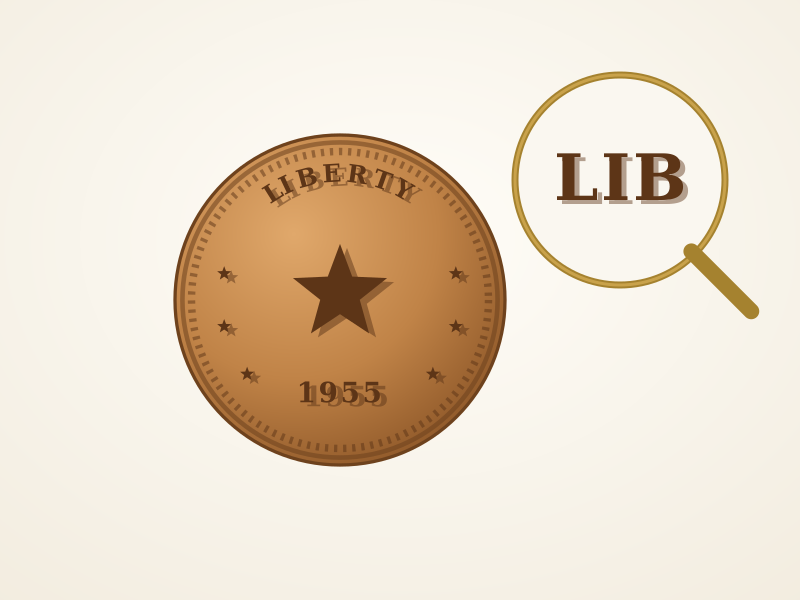
Here's the honest answer up front: most Lincoln wheat cents (1909-1958) are worth 3 to 10 cents each. Common dates were struck by the hundreds of millions, and no amount of wishing changes that. But hiding inside that mountain of common coins are a handful of date-and-mint-mark combinations worth hundreds, thousands, and in two famous cases, six figures. This guide covers exactly which ones to pull, how to verify them, and how to avoid the fakes that stalk every one of these coins.
The two things you check on every wheat cent: the date, and the spot directly below it, where the mint mark lives. No letter means Philadelphia; a D means Denver; an S means San Francisco. That tiny letter is usually the whole ballgame.
1909-S VDB: The Most Famous Cent in America
The very first Lincoln cents carried designer Victor D. Brenner's initials, V.D.B., at the bottom of the reverse between the wheat stalks. Public outcry over the 'advertising' got them removed within days, but not before San Francisco struck just 484,000 coins. That combination of the scarce S mint mark and the short-lived initials made the 1909-S VDB the key to the whole series.
Value: $650 to $2,500+, even heavily worn.
How to check: look for an S under the date on the front, then flip the coin and confirm the small raised V.D.B. centered on the bottom rim of the back. Here's the trap — because plain 1909 VDB cents (no S) are common, fakers add phony S mint marks to them. Compare the S shape against certified photos, and for a coin at this price, get it graded before you buy or sell. See our lesson on professional grading for when certification is worth the fee.
1914-D: The Sleeper Key Date
Nobody saved 1914-D cents when they were new, so this low-mintage Denver date is genuinely tough in every grade. It's the most valuable regular-issue wheat cent after the 1909-S VDB.
Value: $150 to $3,000+ depending on wear.
Diagnostics matter here because the classic forgery is shaving the first 4 off a common 1944-D. On a genuine 1914-D, the 9 and 1 in the date are spaced noticeably wide apart, and Lincoln's shoulder has no designer initials — those didn't appear on the shoulder until 1918. A '1914-D' with initials on the shoulder is an altered 1944.
1922 No D: The Penny That Shouldn't Exist
In 1922, only Denver struck cents — every single one should have a D. But one overworked, grease-clogged die pair struck coins with no visible mint mark at all, and a coin that should be impossible became famous overnight. This is technically a grease-filled die error that turned into a six-hundred-dollar variety.
Value: $400 to $5,000+, and authentication is strongly recommended.
The details separate the real thing from the pretenders. The valuable coins are the 'Die Pair 2' strikes: absolutely no trace of a D below the date, a sharp, well-struck reverse, and a second 2 in the date that's stronger than the first. A faint-but-visible D, or a mushy reverse, means you have a far cheaper 'Weak D' coin instead.
1943 Bronze and 1944 Steel: The Wrong-Metal Legends
In 1943, copper went to the war effort and cents were struck in zinc-coated steel. A few leftover bronze blanks from 1942 slipped into the presses anyway — only about two dozen exist, making the 1943 bronze cent the most famous wrong planchet error in American coinage. Value: $100,000 to $1,000,000+. In 1944 the mistake ran in reverse: the Mint switched back to brass, but roughly 30 to 40 leftover steel blanks got struck. Value: $25,000 to $125,000+.
The magnet is your lie detector. A normal 1943 steel cent sticks to a magnet; a genuine 1943 bronze does not. Copper-plated steel fakes still stick. Then weigh it: bronze runs about 3.11 grams, steel about 2.7. Finally, the 3 in a genuine 1943 date has a long, straight tail — fakers alter 1945s and 1948s, and the digit shapes give them away. For 1944, the test flips: a silvery 1944 cent that a magnet grabs deserves a very close look, while a silver-plated ordinary 1944 won't stick. Either coin must be professionally authenticated — no exceptions at these prices.
1955 Doubled Die Obverse: The One You Can See Across the Room
The most famous doubled die ever made. A misaligned die impression doubled the entire front of the coin, and about 20,000 to 24,000 escaped into circulation, many handed out as cigarette-machine change in the Northeast.
Value: $1,000 to $18,000+ depending on wear.
You don't need a loupe. The date, LIBERTY, and IN GOD WE TRUST all show bold, fully separated doubling — like the words were printed twice, slightly apart. If the doubling looks flat and shelf-like, or only smears parts of letters, you have the common 'poor man's double die' from machine doubling, which adds nothing. Our FAQ covers the doubled-die-versus-machine-doubling test in detail, because it's the single most common false alarm in the hobby.
Worth Pulling, Even If They Won't Retire You
A second tier of dates deserves a spot in your keeper pile:
- 1909-S (no VDB): $80-$350 circulated
- 1931-S: under a million struck, $60-$150
- 1924-D: $30-$200, tough in any grade
- 1926-S: $10 worn, $150+ with light wear
- 1922-D with a clear D: $15-$100
And the Other 99.9%?
Common wheat cents are worth 3 to 10 cents each — more than face value, so keep every one, but nobody's buying a car with a coffee can of 1950s pennies. Their real value is practice: every wheatie teaches you to check dates, find mint marks, and spot the odd coin out. When one does look odd, run it through the identifier, check the glossary when a term trips you up, and remember the one unbreakable rule — never clean a coin, no matter how crusty. A dirty original 1914-D is a treasure; a scrubbed one is a cautionary tale.
Check your own coins
Photograph any U.S. coin and see its valuable varieties in seconds.
Identify my coin