Lincoln Penny Errors Worth Money: What to Check Before You Spend That Cent
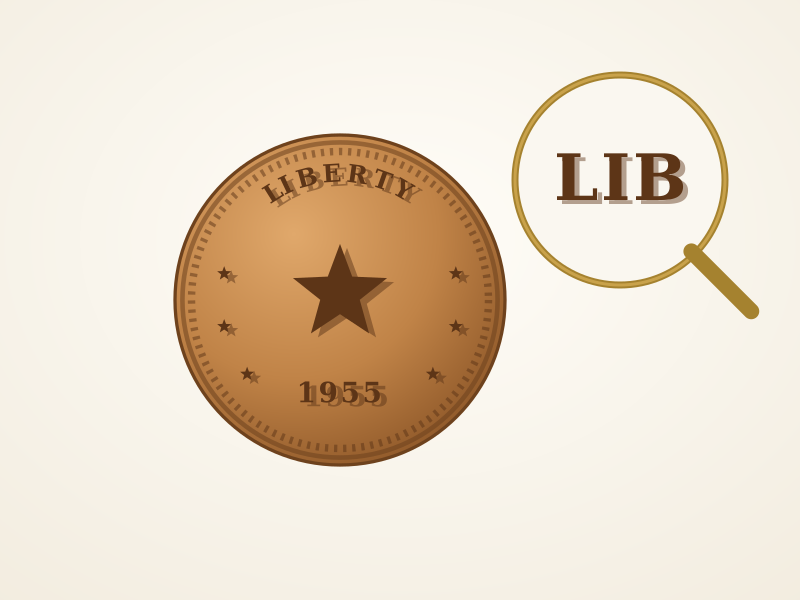
A 1969-S cent with a doubled die obverse has sold for $25,000 to $100,000 or more. A 1955 doubled die runs $1,000 to $18,000 even worn. And a genuine 1943 bronze cent — the most famous error coin in America — is a $100,000 to $1,000,000 coin. All three left the Mint looking like ordinary pennies, and all three were found in ordinary change. Here is exactly what to check before you spend that cent, in the order that pays off fastest.
Step 1: Check the Date and Mint Mark First
Before you hunt errors, rule the big dates in or out. On wheat cents (1909-1958), the mint mark sits below the date, and the money combinations are 1909-S, 1914-D, 1922 with no D, 1931-S — and any 1943 cent that does not stick to a magnet. On Memorial cents (1959-2008), the dates to slow down on are 1969-S, 1972, 1982, 1983, 1984, 1992, 1995, and 1998-2000. Everything below assumes you have a 5x-10x loupe; a $10 one is all you need.
The Doubled Dies: Where the Real Money Is
A doubled die obverse happens when the die itself was made with two slightly offset versions of the design, so every coin it struck shows the same raised, rounded second image — look for notching (little split points) at the corners of letters.
1955 Doubled Die Obverse
The most famous doubled die ever made. You do not even need a loupe: the date, LIBERTY, and IN GOD WE TRUST all show bold, fully separated doubling, like the words were printed twice slightly apart. About 20,000 to 24,000 escaped into circulation, many handed out in cigarette-machine change in the Northeast. Value: $1,000 to $18,000+ depending on wear. Warning: flat, shelf-like doubling on a 1955 cent is the common, worthless "poor man's doubled die" — machine doubling, not the real thing.
1969-S Doubled Die Obverse
So convincing that the Secret Service initially confiscated examples as counterfeits. Fewer than a hundred are known. Look for bold, separated doubling on LIBERTY, IN GOD WE TRUST, and the date — but crucially not on the S mint mark. Mint marks were punched into dies separately in 1969, so a doubled S means worthless machine doubling. Value: $25,000 to $100,000+, and certification is a must.
1972, 1983, 1984, and 1995
- 1972 (Die 1): obvious doubling on LIBERTY, IN GOD WE TRUST, and the date, with a tiny die gouge above the D of GOD as confirmation. Roughly 75,000 to 250,000 were struck, so roll searchers still find them. Worth $100 to $700.
- 1983 Doubled Die Reverse: flip it over — ONE CENT and UNITED STATES OF AMERICA show a bold second outline on every letter. Worth $50 to $400, and thousands exist, so it is genuinely findable. See doubled die reverse for the full diagnostic.
- 1984 Doubled Ear: the doubling hides on Lincoln himself — a clear second earlobe below the normal one. The date and mottos look normal, which is why it slips past casual checks. Worth $50 to $250.
- 1995: the perfect first doubled die. Clear doubling on LIB and GOD, tens of thousands exist, and it still brings $20 to $75.
The Wrong-Metal Rarities: Get Out a Magnet and a Scale
A wrong planchet error means the coin was struck on a blank meant for something else, and the two most famous examples in all of coin collecting are pennies.
- 1943 Bronze Cent: 1943 cents were supposed to be zinc-coated steel. A few leftover bronze blanks from 1942 got struck anyway — only about two dozen exist. Test: steel sticks to a magnet, bronze does not. Then weigh it: bronze is about 3.11 grams versus 2.7 for steel. Copper-plated steel fakes still stick to the magnet. Genuine examples run $100,000 to $1,000,000+.
- 1944 Steel Cent: the reverse mistake — leftover steel blanks struck in 1944, roughly 30 to 40 known. Any 1944 cent a magnet grabs deserves a very close look. Worth $25,000 to $125,000+.
- 1982-D Small Date Copper: the modern transitional rarity. Confirm the Small Date (thin digits aligned along the top, weak curved top on the 2), then weigh it: copper is about 3.11 g, zinc 2.5 g. A 1982-D Small Date at 3.1 g is a $10,000 to $25,000+ coin.
All three demand professional authentication — fakes outnumber genuine coins by a wide margin.
The AM Gap: A 30-Second Check on 1992-2000 Cents
On the reverse, look at the A and M of AMERICA. On a 1992 or 1992-D cent, the letters should have a clear gap — if their bases nearly touch, you have a Close AM, with only about 20 known between the two mints and values of $3,000 to $25,000+. The mix-up runs the other way on 1998, 1999, and 2000 Philadelphia cents: a clear gap between A and M (Wide AM) is the error. The 1999 is the prize at $75 to $500; the 1998 and 2000 bring $5 to $25.
Honorable Mentions Under $100
- 1922 No D: in 1922 only Denver struck cents, but one grease-clogged die pair left no visible D at all. The valuable Die Pair 2 coins have a sharp reverse and bring $400 to $5,000+. Read up on grease-filled dies before celebrating — a faint-but-there D is the much cheaper Weak D.
- Off-center strikes: a cent struck 10% off-center brings $5 to $15; 50% off-center with a full readable date brings $50 to $100+. No date, big discount.
- BIE cents: a small die chip between the B and E of LIBERTY that looks like an extra letter I. Only $5 to $20, but a fun, common find. See die breaks.
- 2017-P: not an error, but the only P-mint-mark penny ever made — save crisp ones.
The Trap That Costs Beginners the Most
The number one false positive in all of error collecting is machine doubling: the die bounced at the moment of striking and smeared a flat, shelf-like step onto the letters. It is incredibly common and worth essentially nothing. The test: true doubled die doubling is raised, rounded, and full-bodied with notched letter corners; machine doubling is flat, shiny, and shelf-like, and it makes letters look thinner than normal. Flat + shelf + thinned letters = spend it.
Found something promising? Snap a photo and run it through the MintMark identifier to narrow down what you have, or browse the learning guides and FAQ to sharpen your eye. Most pennies are worth one cent — but the exceptions above are exactly why checking takes thirty seconds and skipping it can cost thousands.
Check your own coins
Photograph any U.S. coin and see its valuable varieties in seconds.
Identify my coin